Moonwishes Sewing and Crafts

Visit Our Store!
Monday, June 01, 2020
Hand Embroidery - Lotus Flower Embroidery
This lady is incredible in both her embroidery and the way she uses variegated threads!


Tuesday, June 18, 2019
What is different in the Alpha-bets of Vintage Samplers than current Ones?
Over the years, I have seen many copies of vintage samplers that little girls learned their alphabet from making them. However, depending on the year, you will note that the letter appears to be missing. Then no longer. It is simple really. There was no such thing as the letter J for a very long time and the I was used in place of it.
So if you really want a sampler that you are embroidering to look authentically old, leave that J out and just use the I.
Curious and want to learn more? Check out these links:
https://www.rd.com/culture/last-letter-added-to-the-alphabet/
https://www.dictionary.com/e/j/
https://en.wikipedia.org/wiki/J
So if you really want a sampler that you are embroidering to look authentically old, leave that J out and just use the I.
Curious and want to learn more? Check out these links:
https://www.rd.com/culture/last-letter-added-to-the-alphabet/
https://www.dictionary.com/e/j/
https://en.wikipedia.org/wiki/J
Sunday, May 19, 2019
Pattern Companies Combine!
Yes, I know that the fact that McCall's, Butterick and Vogue has combined with Kwik Sew. But for those that wanted a bit more enlightenment, here is a short piece about it: https://www.threadsmagazine.com/2012/02/09/mccalls-and-kwik-sew-join-forces At times people have asked the difference between the three 'main' companies and even though I sensed it, I couldn't give an easy coherent statement, but this article does. "The company is known for its quality and variety of pattern designs: Butterick specializes in classic designs; Vogue offers couture style; and McCall’s features designs for the contemporary sewer."
I know I haven't been writing as much lately, but this has been a hard year for me and something always gets left in the wayside. I am working hard though. One of the things I am trying to get done, is separate the patterns in my store, Moonwishes Sewing and Crafts, into smaller sub-categories to make it easier for each of you to find the type of pattern you are looking for. This is so instead of wading through almost 200 costume patterns, you can select what type you are looking for, since now Cosplay has its own category and men's patterns aren't mixed in with girls unless they were made that way. This is actually the section I am working on currently. I chose to do smaller categories first before biting off the Misses patterns which has over 5000 patterns in it. However, just because I'm not actively working in that section or others, doesn't mean some patterns aren't going into their proper sub-category as I work with patterns after one has been sold or I am making new listings. I hope this will be beneficial to all of you. I have seen some pattern sellers stores and they divided up their Misses patterns for instance, by sizes which means they have a category for every different size. It makes my eyes turn in circles to even look at the categories. I hope what I am doing makes sense to all of you and that it will help you when looking for a specific type pattern.

Because I don't really have enough going on in my life I decided I needed a hobby! LOL! Actually, what I needed was a hobby that I could reasonably be sure that I could finish it in an hour or less. As my strength dissipates, I am finding less and less time is being spent in my sewing room. I was blessed to be given all sorts of markers, paints, etc. and in my thrift store excursions over the last 2+ years, I have found stamps, papers, etc. I'm ready to go! Of course I still want to quilt, sew, and embroider. Here is a photo of my 'first card for a friend that lost her husband recently. Sort of messy I discovered when looking at the close-up of the photo! Well if I was perfect the first time, what is the point of trying? Now I know some of the problems to look out for. I even got to get a spiffy Gemini Junior for die cutting and embossing which is how I cut out the big butterfly. What a hand saver!
For those that don't follow me anywhere but here, here are some photos of my grandbaby Rosemary. The first with her Daddy who looks so pleased. And a more recent one where she looked a bit ready to give a speech so I helped her out! Her last photos came to me via actual photographs and my scanner isn't working right now so can't post any of those, but she is over 7 months now! Time flies and we should get to see them in July.


I know I haven't been writing as much lately, but this has been a hard year for me and something always gets left in the wayside. I am working hard though. One of the things I am trying to get done, is separate the patterns in my store, Moonwishes Sewing and Crafts, into smaller sub-categories to make it easier for each of you to find the type of pattern you are looking for. This is so instead of wading through almost 200 costume patterns, you can select what type you are looking for, since now Cosplay has its own category and men's patterns aren't mixed in with girls unless they were made that way. This is actually the section I am working on currently. I chose to do smaller categories first before biting off the Misses patterns which has over 5000 patterns in it. However, just because I'm not actively working in that section or others, doesn't mean some patterns aren't going into their proper sub-category as I work with patterns after one has been sold or I am making new listings. I hope this will be beneficial to all of you. I have seen some pattern sellers stores and they divided up their Misses patterns for instance, by sizes which means they have a category for every different size. It makes my eyes turn in circles to even look at the categories. I hope what I am doing makes sense to all of you and that it will help you when looking for a specific type pattern.

Because I don't really have enough going on in my life I decided I needed a hobby! LOL! Actually, what I needed was a hobby that I could reasonably be sure that I could finish it in an hour or less. As my strength dissipates, I am finding less and less time is being spent in my sewing room. I was blessed to be given all sorts of markers, paints, etc. and in my thrift store excursions over the last 2+ years, I have found stamps, papers, etc. I'm ready to go! Of course I still want to quilt, sew, and embroider. Here is a photo of my 'first card for a friend that lost her husband recently. Sort of messy I discovered when looking at the close-up of the photo! Well if I was perfect the first time, what is the point of trying? Now I know some of the problems to look out for. I even got to get a spiffy Gemini Junior for die cutting and embossing which is how I cut out the big butterfly. What a hand saver!
For those that don't follow me anywhere but here, here are some photos of my grandbaby Rosemary. The first with her Daddy who looks so pleased. And a more recent one where she looked a bit ready to give a speech so I helped her out! Her last photos came to me via actual photographs and my scanner isn't working right now so can't post any of those, but she is over 7 months now! Time flies and we should get to see them in July.

Wednesday, November 21, 2018
Vintage Fabric Score!
 |
| Dutch People fabric |
Sunday, July 29, 2018
Hexagon and Millefiori Pieced Quilts Helper

My son had asked me to help him find something to help
occupy the neighborhood kids that land on his front porch, many from less than
stellar home lives. So, he and his pregnant wife (my first grandbaby!) are
showing love and kindness to these kids, but they do need some 'toys'. I love thinking outside the box
to find uses for things that the maker never imagined it to be used for. For
me I like giving children items that help them think and gain knowledge from
the play. I think this is what is behind the STEM system that is currently
popular with schools. So, when this item ETA hand2mind Pattern Blocks Games
for Classroom or Home came up for review I got it. This set is well
made, and quilts aside, does have activities and games for the children to
play.
What I found is that the pieces of this game include, I
believe, all the different shapes to make hexagon paper pieced blocks. If you
want to try to design a different styled block you can do that. As there are
only 10 each of the shapes, you may want to get a supplemental set of
shapes such as Learning Resources
Plastic Pattern Blocks (Set of 250 pieces of 6 different shapes). This is where you
can find enough shapes if you want to design a Millefiori style quilt top.
While you won't have the shapes in the colors that you want to use, being able
to figure out a logical structure with premade shapes should make things go
smoother. I am dyslexic and seeing those quilts, while beautiful, I'm pretty
sure I couldn't put even a small quilt without some help of pre-made
‘templates’.
One of the things that comes with this kit which isn't made
to help quilters but are for children are patterns to make of assorted animals
and other objects. You can also buy Learning Advantage 8837 Pattern Block
Activity Cards (Pack of 20) to help give your youngster ideas. At that
point you and your child can design hexagon blocks together and make them
into a quilt of different designs. What is better than getting a child into
quilting and sewing and using their creative minds plus the bonus of working
together on a project with an adult?
My
apologies for not being able to have embedded links to each of these sets.
Amazon wouldn't generate them for me. I will add them when I am able.
Embroidery Library Christmas Club 2018

Tuesday, July 10, 2018
Quilt Labels Using a Printer and Freezer Paper
We are in an extraordinary age for crafting. We have so many types of supplies that of foremothers never even thought of or hoped to have. Thus most likely WHY many never signed their quilts or documented them in any way except for perhaps embroidering their initials and the year. I suspect many never thought that their quilts would outlive them and they were meant for family use and everyone in the family already knew who made it. As I have read about vintage quilts, it seems the special, guest or gift quilts had the best chance of being documented. Now we have no excuse!
My son and his wife are expecting a baby girl in a few months. Since they live a distance from us, and were up visiting this week, I gave them the baby quilt I had made for them. I actually finished it while they were here. I also ran into an excellent YouTube video on Printing on Fabric using Freezer Paper. I watched it twice before trying the process and then once more to be sure I finished the process quickly. Here is a photo of the finished label:

As this was a baby quilt for my very first grandbaby, I wanted to be sure that all the documentation was there, just in case a few of us are dead before she gets old enough to know us! One of the nice things about doing the label this way was being able to show a motif from the fabric itself on the label.
In a nutshell here is how it was done and if you are interested visit the video about it at: https://www.youtube.com/watch?v=DfzTXlkQr5o&t=4s . I set up the design and printing that I wanted on the computer. I used the Comic Sans MS for the lettering just because I liked it, but you can use any of the fonts you may have available on your computer. I printed out a copy of the paper so I could check if the label printed the correct way. My printer was acting up and printing out the label that took more than an 8 x 11 1/2" which was not what I wanted. So I juggled that. As the yellow fabric was the only light colored fabric that I had used in the quilt I decided to use that as the fabric for the label. Iron the fabric on both sides until there are no wrinkles. Then either cut a piece of Freezer Paper I use Reynolds if needed, but it needs to have a waxy coating on the back and can be picked up at grocery stores, Walmart and Amazon. I used C&T Publishing Pre-cut freezer paper to 8 x 11 1/2". I ironed the paper and fabric (it must be at least as large as a piece of copy paper) until it was stuck really well. Let it cool for a few minutes and then ran it through my Samsung Color Laser Printer CLP-365W . Note: If you aren't sure what side will print, I always place and large X on the next page to print, print something on the page and you can see if you need to lay your fabric/freezer paper combo up or down. Lay it in the machine. Adjust it to thick paper. There is apparently a manual feed to the printer but it must be behind the printer and my sewing room is too crowded to turn the printer around to look for it, so I only set the thick paper. It went through with no problem. After that I carefully took the freezer paper off of the fabric and pressed it with a hot iron then cut it down to size As my quilt had already been quilted, I had to attach fabric to the label then turned it inside out and hand sewed it to the quilt. If you quilt isn't quilted yet, you could sew the label on with a machine if you wish.


The quilt is based off of design I found in a quilting magazine and I will have to find the magazine to give proper credit. My mother had given me all her boxes of quilting fabric when she just couldn't sew anymore. In one of the boxes was a lot of juvenile prints including this frog fabric, big frogs, small frogs and striped with frogs and lots of fabric to match. They came in both blue and the pink. I had originally made up the quilt top along with a matching blue one for Project Linus, but found I was having a horrible time just quilting in the ditch so while the blue one is almost finished with the stitch in the ditch, the pink one I hadn't even started quilting. Even pushing the bulk of a baby quilt around is almost more than my neck and shoulders can tolerate. My wonderful cleaning lady said she would quilt it for me and quilted it by hand in time for me to be able to give it to them when they were up visiting for the 4th of July. So thankful in many ways for Jeanette and the help she given me as I continue to battle arthritis. She knew it was important for me to get this quilt done.
If you need a way to make quilt labels and well as photos printed to fabric with lettering to say who each person is. This process would be wonderful! Every quilter should have freezer paper in their sewing room!
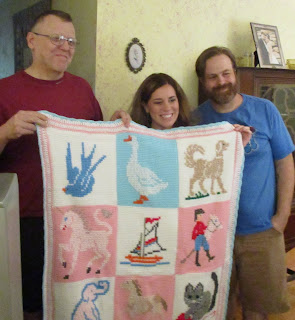
Years ago my hubby, the tall guy on the left, crocheted this baby blanket and hadn't found a bay to give it to. Now that he will become a grandpa, he has found his baby! He did a fantastic job on the blanket and the kids were very happy with the blanket and quilt, plus all the other goodies that grandma had rounded up since Easter when we found out she was expecting.
I forgot to give credit where credit is due. The pink frog quilt is based off a quilt in The Quilter Magazine February/March 2001 by Pam See called What a Hoot. That quilt was a bit bigger than the one I made.
My son and his wife are expecting a baby girl in a few months. Since they live a distance from us, and were up visiting this week, I gave them the baby quilt I had made for them. I actually finished it while they were here. I also ran into an excellent YouTube video on Printing on Fabric using Freezer Paper. I watched it twice before trying the process and then once more to be sure I finished the process quickly. Here is a photo of the finished label:

As this was a baby quilt for my very first grandbaby, I wanted to be sure that all the documentation was there, just in case a few of us are dead before she gets old enough to know us! One of the nice things about doing the label this way was being able to show a motif from the fabric itself on the label.
In a nutshell here is how it was done and if you are interested visit the video about it at: https://www.youtube.com/watch?v=DfzTXlkQr5o&t=4s . I set up the design and printing that I wanted on the computer. I used the Comic Sans MS for the lettering just because I liked it, but you can use any of the fonts you may have available on your computer. I printed out a copy of the paper so I could check if the label printed the correct way. My printer was acting up and printing out the label that took more than an 8 x 11 1/2" which was not what I wanted. So I juggled that. As the yellow fabric was the only light colored fabric that I had used in the quilt I decided to use that as the fabric for the label. Iron the fabric on both sides until there are no wrinkles. Then either cut a piece of Freezer Paper I use Reynolds if needed, but it needs to have a waxy coating on the back and can be picked up at grocery stores, Walmart and Amazon. I used C&T Publishing Pre-cut freezer paper to 8 x 11 1/2". I ironed the paper and fabric (it must be at least as large as a piece of copy paper) until it was stuck really well. Let it cool for a few minutes and then ran it through my Samsung Color Laser Printer CLP-365W . Note: If you aren't sure what side will print, I always place and large X on the next page to print, print something on the page and you can see if you need to lay your fabric/freezer paper combo up or down. Lay it in the machine. Adjust it to thick paper. There is apparently a manual feed to the printer but it must be behind the printer and my sewing room is too crowded to turn the printer around to look for it, so I only set the thick paper. It went through with no problem. After that I carefully took the freezer paper off of the fabric and pressed it with a hot iron then cut it down to size As my quilt had already been quilted, I had to attach fabric to the label then turned it inside out and hand sewed it to the quilt. If you quilt isn't quilted yet, you could sew the label on with a machine if you wish.


The quilt is based off of design I found in a quilting magazine and I will have to find the magazine to give proper credit. My mother had given me all her boxes of quilting fabric when she just couldn't sew anymore. In one of the boxes was a lot of juvenile prints including this frog fabric, big frogs, small frogs and striped with frogs and lots of fabric to match. They came in both blue and the pink. I had originally made up the quilt top along with a matching blue one for Project Linus, but found I was having a horrible time just quilting in the ditch so while the blue one is almost finished with the stitch in the ditch, the pink one I hadn't even started quilting. Even pushing the bulk of a baby quilt around is almost more than my neck and shoulders can tolerate. My wonderful cleaning lady said she would quilt it for me and quilted it by hand in time for me to be able to give it to them when they were up visiting for the 4th of July. So thankful in many ways for Jeanette and the help she given me as I continue to battle arthritis. She knew it was important for me to get this quilt done.
If you need a way to make quilt labels and well as photos printed to fabric with lettering to say who each person is. This process would be wonderful! Every quilter should have freezer paper in their sewing room!

Years ago my hubby, the tall guy on the left, crocheted this baby blanket and hadn't found a bay to give it to. Now that he will become a grandpa, he has found his baby! He did a fantastic job on the blanket and the kids were very happy with the blanket and quilt, plus all the other goodies that grandma had rounded up since Easter when we found out she was expecting.
I forgot to give credit where credit is due. The pink frog quilt is based off a quilt in The Quilter Magazine February/March 2001 by Pam See called What a Hoot. That quilt was a bit bigger than the one I made.
Monday, June 25, 2018
Apron Machine Embroidery Design
Even though I haven't been posting a lot here, I have done some projects. Those with machine embroidered designs from Embroidery Library, I try to turn them in for their showcase. I have had several posted on their Showcase over the years. Today I received another email saying another item has been posted. Click this link to Embroidery Library, click on the inspirations button and then Showcase. Or you can click on this link to see it: My project is the Peace, Love and Bacon design and my name Gail to identify it.

My oldest son loves bacon and eats it in many ways that would appear to be weird to most of us, so when I saw this design, I knew I had to use it for him! It was easy to embroider onto this apron that I had gotten to review for the Amazon Vine program. So it was a fun easy project to do. And yes, shame on me for not ironing the apron before taking it's photo!

My oldest son loves bacon and eats it in many ways that would appear to be weird to most of us, so when I saw this design, I knew I had to use it for him! It was easy to embroider onto this apron that I had gotten to review for the Amazon Vine program. So it was a fun easy project to do. And yes, shame on me for not ironing the apron before taking it's photo!
Subscribe to:
Posts (Atom)